
Clinical research is a field that offers diverse career paths and a wide range of job opportunities for healthcare graduates. Among the most sought-after clinical research associate vs clinical data manager roles. Clinical Research Associate and Clinical Data Manager both play a vital role in ensuring the success and integrity of clinical trials. But they are different in terms of job responsibilities, required skill sets, work environment, and clinical research associate vs clinical data manager career path growth trajectory.
In this blog, we will discuss the clinical research associate vs clinical data manager salary, pros and cons, clinical research associate vs clinical data manager roles, Clinical Research Associate vs Clinical Data Manager Responsibilities, which can help you make a clear decision for your clinical research associate vs clinical data management (CRA vs CDM career)choice in the clinical research field
Clinical Research Associate vs Clinical Data Manager Roles
The CRA vs CDM difference can be understood by comparing their roles, responsibilities, work settings, required skills, and involvement in clinical research and data management.
Clinical Research Associate (CRA) Role
The key role of a Clinical Research Associate is to act as a bridge between the sponsor, such as a pharmaceutical company, CRO and the clinical trial site. These professionals carry out the tasks of monitoring clinical trials, ensuring data accuracy, regulatory compliance, and adherence to study protocols at hospitals or research centres.
Clinical Data Manager (CDM) Role
The key role of a Clinical Data Manager is to oversee and manage the collection, validation, and analysis of clinical trial data. CDMs ensure that all data captured during a clinical trial is complete, accurate, and consistent before submission to regulatory authorities.
Clinical Research Associate vs Clinical Data Manager Responsibilities
A Clinical Research Associate is primarily responsible for site selection, monitoring visits, protocol compliance checks, source data verification and ensuring GCP adherence at trial sites, while a Clinical Data Manager focuses on database design, data validation, query resolution and ensuring clean, analysis-ready datasets. In this clinical research associate vs clinical data management comparison, the CRA role is field-and-site-facing, involving direct interaction with investigators and coordinators, whereas the CDM role is largely desk-based, working within EDC systems like Medidata Rave or Oracle Clinical.
Overall, the clinical research associate vs clinical data manager responsibilities distinction comes down to operational trial oversight versus data integrity management CRAs ensure trials run compliantly on the ground, while CDMs ensure the resulting data is accurate, complete and ready for statistical analysis.
Clinical Research Associate (CRA) Key Responsibilities:
- CRAs have to conduct site selection and do initiation visits
- Monitor ongoing trials and ensure that data integrity is the most crucial task performed by them
- They also verify source documents and case report forms (CRFs)
- Clinical research associates have to ensure adherence to Good Clinical Practice (GCP) and ethical standards.
- Coordinate between investigators, sponsors, and CROs is the key responsibility
Clinical Data Manager (CDM) Key Responsibilities:
- Clinical Data Managers carry out tasks such as designing and managing electronic data capture (EDC) systems
- They also perform data cleaning and query management, and maintain data accuracy and consistency
- CDM professionals also have to generate clinical data reports for analysis and collaborate with statisticians and medical writers
Qualifications and Skills Required
The difference between clinical research associate and clinical data manager starts with background CRAs typically hold a life sciences/pharmacy/nursing degree with strong site-facing and communication skills, while CDMs come from a life sciences or IT-adjacent background with database and CDISC (SDTM/ADaM) skills using tools like Medidata Rave.
Another key difference between clinical research associate and clinical data manager under Qualifications and Skills Required is orientation CRAs need attention to detail and stakeholder management for site monitoring, while CDMs need analytical and technical rigor for data cleaning and query resolution.
In short, the difference between clinical research associate and clinical data manager is people-facing compliance skills for CRAs versus data-focused technical skills for CDMs.
For CRA:
- Educational background in life sciences, pharmacy, nursing, or medical fields
- Knowledge of GCP, ICH, and clinical trial regulations
- Excellent communication, observation, and organisational skills
- Willingness to travel and manage multiple trial sites
For CDM:
- Background in life sciences, computer science, or bioinformatics
- Strong analytical and technical skills
- Proficiency in EDC tools (e.g., Medidata, Oracle Clinical, Rave)
- Attention to detail and ability to manage large datasets
Clinical Research Associate vs Clinical Data Manager Salary & Career Growth Outlook

Both clinical research associate vs clinical data manager salary have global demand, and skilled professionals often find opportunities with multinational CROs, pharmaceutical companies, and biotech firms.
When comparing CRA vs Clinical Data Manager Salary, both roles start on relatively comparable footing, but their trajectories of CRA vs CDM difference with experience. CRA roles tend to have an early edge due to travel-linked allowances and site-monitoring responsibilities, while CDM roles typically build steadier growth as professionals move into senior data management and biostatistics-adjacent positions.
Looking further at CRA vs Clinical Data Manager Salary trends, both roles offer strong earning potential at senior levels CRAs benefit from international monitoring assignments, while CDMs gain from specialization in CDISC standards, EDC platforms (like Medidata Rave) and clinical data programming. Overall, in the CRA vs Clinical Data Manager Salary comparison, CRA offers a stronger early-career edge through field allowances, while CDM provides more stable, desk-based growth with solid long-term prospects in data-heavy, tech-driven roles.
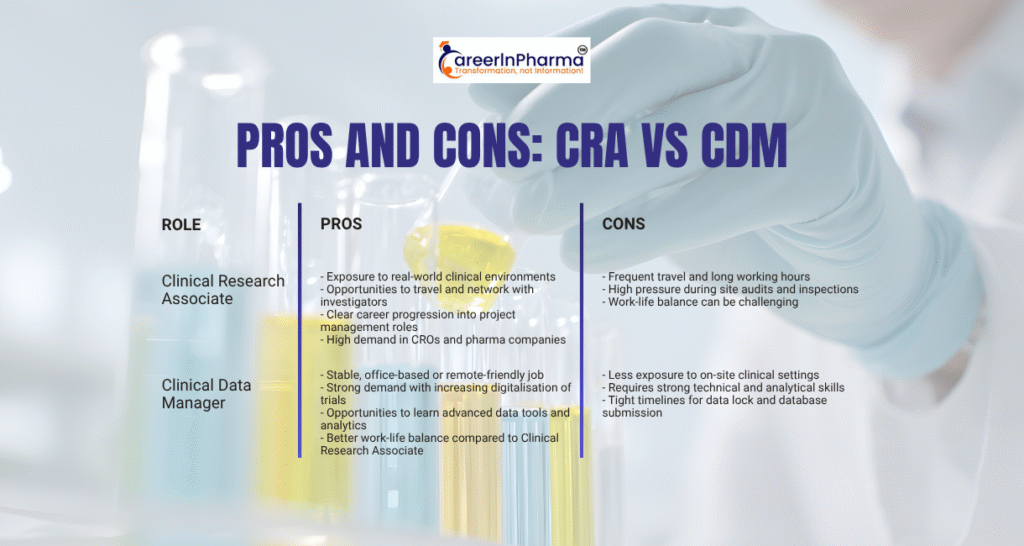
Pros and Cons: CRA vs CDM career
Which Is Better — CRA vs CDM career?
Your choice depends on your interests and strengths: CRA vs CDM difference
- If you enjoy fieldwork, communication, and coordination, CRA might suit you better.
- If you prefer data accuracy, analysis, and working with technology, CDM could be your ideal fit.
Offer stable and rewarding clinical research associate vs clinical data manager career paths in the expanding clinical research industry.
Conclusion
The fields of Clinical Research Associate and Clinical Data Manager both offer a great career scope in India and abroad. However, entering such fields can be confusing and overwhelming. With the help of proper training and support, you can achieve your clinical research associate vs clinical data manager career path goal. CareerInPharma offers industry-oriented online training programs in clinical research associate vs clinical data management designed to make you job-ready. Our expert-led modules, real-world case studies, and placement support help you confidently enter the clinical research domain and build a successful career, whether as a Clinical Research Associate or a Clinical Data Manager.
FAQs about Clinical research associate or clinical data manager
1. Which role has more travel — CRA vs CDM?
CRA involves frequent travel to clinical trial sites, while CDM is mostly office-based or remote.
2. Can a CRA transition to a CDM role?
Yes, with proper training in data management tools and software, a CRA can move into CDM roles.
3. Is Clinical Research a good career in India?
Absolutely. With the growth of global trials, India’s demand for trained professionals in both CRA and CDM roles is increasing rapidly.
4. What is the future scope of Clinical Research Associate or Clinical Data Manager roles?
Both roles have excellent career prospects due to the growing number of clinical trials globally. With the rise of digital data capture and remote monitoring, CRAs and CDMs are expected to remain in high demand in CROs, pharma, and biotech companies.
5. Do I need prior experience to become a CRA vs CDM?
Not necessarily. Freshers from life science, pharmacy, or medical backgrounds can enter these fields through professional training programs that provide practical knowledge and internship opportunities.
6. Which job is better for work-life balance — clinical research associate or clinical data manager?
The Clinical Data Manager role generally offers better work-life balance since it’s mostly office-based or remote, whereas the CRA role involves frequent travel and tighter schedules.